#include <Scalar.h>
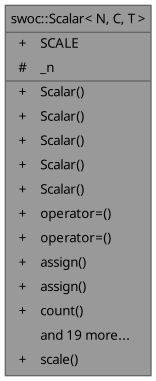
Public Types | |
| using | Counter = C |
| Type used to hold the count. | |
| using | Tag = T |
| Tag for the scalar. | |
Public Member Functions | |
| constexpr | Scalar () |
| Default constructor. | |
| constexpr | Scalar (Counter n) |
| Construct to have value that is n scaled units. | |
| constexpr | Scalar (self_type const &that) |
| Copy constructor. | |
| template<typename I> | |
| constexpr | Scalar (Scalar< N, I, T > const &that) |
| Copy constructor. | |
| template<intmax_t S, typename I> | |
| constexpr | Scalar (Scalar< S, I, T > const &that) |
| template<intmax_t S, typename I> | |
| self_type & | operator= (Scalar< S, I, T > const &that) |
| self_type & | operator= (self_type const &that) |
| Self type assignment. | |
| self_type & | assign (Counter n) |
| template<intmax_t S, typename I> | |
| self_type & | assign (Scalar< S, I, T > const &that) |
| constexpr Counter | count () const |
| The number of scale units. | |
| constexpr Counter | value () const |
| The scaled value. | |
| constexpr | operator Counter () const |
| User conversion to scaled value. | |
| self_type & | operator+= (self_type const &that) |
| template<intmax_t S, typename I> | |
| self_type & | operator+= (Scalar< S, I, T > const &that) |
| self_type & | operator++ () |
| Increment - increase count by 1. | |
| self_type | operator++ (int) |
| Increment - increase count by 1. | |
| self_type & | operator-- () |
| Decrement - decrease count by 1. | |
| self_type | operator-- (int) |
| Decrement - decrease count by 1. | |
| self_type & | inc (Counter n) |
| Increment by n. | |
| self_type & | dec (Counter n) |
| Decrement by n. | |
| self_type & | operator-= (self_type const &that) |
| template<intmax_t S, typename I> | |
| self_type & | operator-= (Scalar< S, I, T > const &that) |
| self_type & | operator*= (C n) |
| Multiplication - multiple the count by n. | |
| self_type & | operator/= (C n) |
| Division - divide (rounding down) the count by n. | |
| self_type | operator() (Counter n) const |
| Utility overload of the function operator to create instances at the same scale. | |
| self_type | plus (Counter n) const |
| Return a value at the same scale with a count increased by n. | |
| self_type | minus (Counter n) const |
| Return a value at the same scale with a count decreased by n. | |
| template<intmax_t S, typename I> | |
| auto | operator+= (Scalar< S, I, T > const &that) -> self_type & |
| template<intmax_t S, typename I> | |
| auto | operator-= (Scalar< S, I, T > const &that) -> self_type & |
Static Public Member Functions | |
| static constexpr intmax_t | scale () |
| Run time access to the scale (template arg N). | |
Static Public Attributes | |
| static constexpr intmax_t | SCALE = N |
| Scaling factor - make it external accessible. | |
Protected Attributes | |
| Counter | _n |
| Number of scale units. | |
Detailed Description
class swoc::Scalar< N, C, T >
A class to hold scaled values.
Instances of this class have a count and a scale. The "value" of the instance is count * scale. The scale is stored in the compiler in the class symbol table and so only the count is a run time value. An instance with a large scale can be assigned to an instance with a smaller scale and the conversion is done automatically. Conversions from a smaller to larger scale must be explicit using round_up and round_down. This prevents inadvertent changes in value. Because the scales are not the same these conversions can be lossy and the two conversions determine whether, in such a case, the result should be rounded up or down to the nearest scale value.
N sets the scale. C is the type used to hold the count, which is in units of N.
T is a "tag" type which is used only to distinguish the base metric for the scale. Scalar types that have different tags are not interoperable although they can be converted manually by converting to units and then explicitly constructing a new Scalar instance. This is by design. This can be ignored - if not specified then it defaults to a "generic" tag. The type can be (and usually is) defined in name only).
- Note
- This is modeled somewhat on
std::chronoand serves a similar function for different and simpler cases (where the ratio is always an integer, never a fraction).
- See also
- round_up
- round_down
Member Typedef Documentation
◆ Counter
| using swoc::Scalar< N, C, T >::Counter = C |
◆ Tag
| using swoc::Scalar< N, C, T >::Tag = T |
Constructor & Destructor Documentation
◆ Scalar() [1/2]
|
constexpr |
Copy constructor.
Copy constructor for same scale.
◆ Scalar() [2/2]
|
constexpr |
Direct conversion constructor.
- Note
- Requires that
Sbe an integer multiple ofSCALE.
Member Function Documentation
◆ assign() [1/2]
| self_type & swoc::Scalar< N, C, T >::assign | ( | Counter | n | ) |
Set the scaled count to n.
- Parameters
-
n The number of scale units.
- Returns
- this
This sets the count to be n, making the effective value SCALE*n. This is frequently useful for parsing, when the input is also in scaled units (e.g., the number of megabytes to use for a file).
◆ assign() [2/2]
| self_type & swoc::Scalar< N, C, T >::assign | ( | Scalar< S, I, T > const & | that | ) |
The value that is scaled appropriately.
- Note
- Requires the scale of that be an integer multiple of the scale of this. If this isn't the case then the
round_uporround_downmust be used to indicate the rounding direction.
◆ dec()
| auto swoc::Scalar< N, C, T >::dec | ( | Counter | n | ) |
◆ inc()
| auto swoc::Scalar< N, C, T >::inc | ( | Counter | n | ) |
◆ minus()
| auto swoc::Scalar< N, C, T >::minus | ( | Counter | n | ) | const |
◆ operator()()
| auto swoc::Scalar< N, C, T >::operator() | ( | Counter | n | ) | const |
◆ operator*=()
| auto swoc::Scalar< N, C, T >::operator*= | ( | C | n | ) |
◆ operator++() [1/2]
| auto swoc::Scalar< N, C, T >::operator++ | ( | ) |
◆ operator++() [2/2]
| auto swoc::Scalar< N, C, T >::operator++ | ( | int | ) |
◆ operator+=() [1/3]
| self_type & swoc::Scalar< N, C, T >::operator+= | ( | Scalar< S, I, T > const & | that | ) |
Cross scale addition.
- Template Parameters
-
S Source scale. I Source raw type.
- Parameters
-
that Value.
- Returns
- this
that is scaled as needed to be added to this.
◆ operator+=() [2/3]
| auto swoc::Scalar< N, C, T >::operator+= | ( | Scalar< S, I, T > const & | that | ) | -> self_type & |
◆ operator+=() [3/3]
| auto swoc::Scalar< N, C, T >::operator+= | ( | self_type const & | that | ) |
◆ operator--() [1/2]
| auto swoc::Scalar< N, C, T >::operator-- | ( | ) |
◆ operator--() [2/2]
| auto swoc::Scalar< N, C, T >::operator-- | ( | int | ) |
◆ operator-=() [1/3]
| self_type & swoc::Scalar< N, C, T >::operator-= | ( | Scalar< S, I, T > const & | that | ) |
Subtraction.
- Template Parameters
-
S Scale. I Raw type.
- Parameters
-
that Value to subtract.
- Returns
- this
The value of that is subtracted from the value of this.
◆ operator-=() [2/3]
| auto swoc::Scalar< N, C, T >::operator-= | ( | Scalar< S, I, T > const & | that | ) | -> self_type & |
◆ operator-=() [3/3]
| auto swoc::Scalar< N, C, T >::operator-= | ( | self_type const & | that | ) |
◆ operator/=()
| auto swoc::Scalar< N, C, T >::operator/= | ( | C | n | ) |
◆ operator=()
| self_type & swoc::Scalar< N, C, T >::operator= | ( | Scalar< S, I, T > const & | that | ) |
Assign value from that.
- Template Parameters
-
S Scale. I Integral type.
- Parameters
-
that Source value.
- Returns
- this.
- Note
- Requires the scale of that be an integer multiple of the scale of this. If this isn't the case then the
round_uporround_downmust be used to indicate the rounding direction.
◆ plus()
| auto swoc::Scalar< N, C, T >::plus | ( | Counter | n | ) | const |
Member Data Documentation
◆ _n
|
protected |
◆ SCALE
|
staticconstexpr |
The documentation for this class was generated from the following files:
Generated by
 1.13.2