#include <IPRange.h>
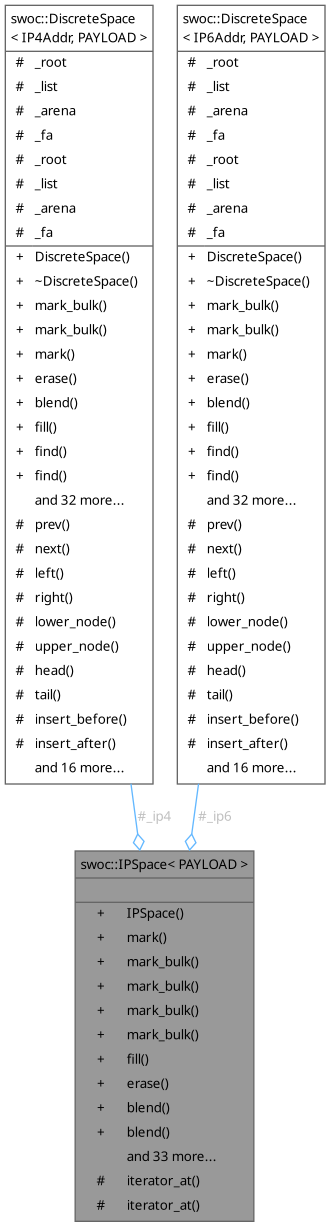
Classes | |
| class | const_iterator |
| class | iterator |
Public Types | |
| using | payload_t = PAYLOAD |
| using | value_type = detail::ip_space_value_type<PAYLOAD> |
| Iterator value, a range and payload. | |
Public Member Functions | |
| IPSpace ()=default | |
| Construct an empty space. | |
| self_type & | mark (IPRange const &range, PAYLOAD const &payload) |
| self_type & | mark_bulk (std::pair< DiscreteRange< IP4Addr >, PAYLOAD > *range_payloads, size_t size, bool is_sorted=false) |
| self_type & | mark_bulk (std::vector< std::pair< DiscreteRange< IP4Addr >, PAYLOAD > > &range_payloads, bool is_sorted=false) |
| vector-based interface for the previous function. | |
| self_type & | mark_bulk (std::pair< DiscreteRange< IP6Addr >, PAYLOAD > *range_payloads, size_t size, bool is_sorted=false) |
| self_type & | mark_bulk (std::vector< std::pair< DiscreteRange< IP6Addr >, PAYLOAD > > &range_payloads, bool is_sorted=false) |
| vector-based interface for the previous function. | |
| self_type & | fill (IPRange const &range, PAYLOAD const &payload) |
| self_type & | erase (IPRange const &range) |
| template<typename F, typename U = PAYLOAD> | |
| self_type & | blend (IPRange const &range, U const &color, F &&blender) |
| template<typename F, typename U = PAYLOAD> | |
| self_type & | blend (IP4Range const &range, U const &color, F &&blender) |
| template<typename F, typename U = PAYLOAD> | |
| self_type & | blend (IP6Range const &range, U const &color, F &&blender) |
| size_t | count () const |
| size_t | count_ip4 () const |
| size_t | count_ip6 () const |
| size_t | count (sa_family_t f) const |
| bool | empty () const |
| void | clear () |
| Remove all ranges. | |
| iterator | find (IPAddr const &addr) |
| const_iterator | find (IPAddr const &addr) const |
| iterator | find (IP4Addr const &addr) |
| const_iterator | find (IP4Addr const &addr) const |
| iterator | find (IP6Addr const &addr) |
| const_iterator | find (IP6Addr const &addr) const |
| iterator | begin () |
| const_iterator | begin () const |
| iterator | end () |
| const_iterator | end () const |
| iterator | begin_ip4 () |
| const_iterator | begin_ip4 () const |
| iterator | end_ip4 () |
| const_iterator | end_ip4 () const |
| iterator | begin_ip6 () |
| const_iterator | begin_ip6 () const |
| iterator | end_ip6 () |
| const_iterator | end_ip6 () const |
| const_iterator | begin (sa_family_t family) const |
| const_iterator | end (sa_family_t family) const |
| std::pair< iterator, iterator > | intersection (IP4Range const &r) |
| std::pair< iterator, iterator > | intersection (IP6Range const &r) |
| std::pair< iterator, iterator > | intersection (IPRange const &r) |
| template<typename F, typename U> | |
| auto | blend (IPRange const &range, U const &color, F &&blender) -> self_type & |
| template<typename F, typename U> | |
| auto | blend (IP4Range const &range, U const &color, F &&blender) -> self_type & |
| template<typename F, typename U> | |
| auto | blend (IP6Range const &range, U const &color, F &&blender) -> self_type & |
Protected Member Functions | |
| iterator | iterator_at (typename IP4Space::const_iterator const &spot) |
| iterator | iterator_at (typename IP6Space::const_iterator const &spot) |
Protected Attributes | |
| IP4Space | _ip4 |
| Sub-space containing IPv4 ranges. | |
| IP6Space | _ip6 |
| sub-space containing IPv6 ranges. | |
Friends | |
| class | IPRangeSet |
Detailed Description
class swoc::IPSpace< PAYLOAD >
Coloring of IP address space.
- Template Parameters
-
PAYLOAD The color class.
This is a class to do fast coloring and lookup of the IP address space. It is range oriented and performs well for ranges, much less well for singletons. Conceptually every IP address is a key in the space and can have a color / payload of type PAYLOAD.
PAYLOAD must have the properties
- Cheap to copy.
- Comparable via the equality and inequality operators.
Member Typedef Documentation
◆ payload_t
| using swoc::IPSpace< PAYLOAD >::payload_t = PAYLOAD |
◆ value_type
| using swoc::IPSpace< PAYLOAD >::value_type = detail::ip_space_value_type<PAYLOAD> |
Member Function Documentation
◆ begin() [1/3]
| auto swoc::IPSpace< PAYLOAD >::begin | ( | ) |
◆ begin() [2/3]
| auto swoc::IPSpace< PAYLOAD >::begin | ( | ) | const |
◆ begin() [3/3]
| auto swoc::IPSpace< PAYLOAD >::begin | ( | sa_family_t | family | ) | const |
◆ begin_ip4() [1/2]
| auto swoc::IPSpace< PAYLOAD >::begin_ip4 | ( | ) |
◆ begin_ip4() [2/2]
| auto swoc::IPSpace< PAYLOAD >::begin_ip4 | ( | ) | const |
◆ begin_ip6() [1/2]
| auto swoc::IPSpace< PAYLOAD >::begin_ip6 | ( | ) |
◆ begin_ip6() [2/2]
| auto swoc::IPSpace< PAYLOAD >::begin_ip6 | ( | ) | const |
◆ blend() [1/4]
| auto swoc::IPSpace< PAYLOAD >::blend | ( | IP4Range const & | range, |
| U const & | color, | ||
| F && | blender ) -> self_type & |
◆ blend() [2/4]
| auto swoc::IPSpace< PAYLOAD >::blend | ( | IP6Range const & | range, |
| U const & | color, | ||
| F && | blender ) -> self_type & |
◆ blend() [3/4]
| self_type & swoc::IPSpace< PAYLOAD >::blend | ( | IPRange const & | range, |
| U const & | color, | ||
| F && | blender ) |
Blend color in to the range.
- Template Parameters
-
F Blending functor type (deduced). U Data to blend in to payloads.
- Parameters
-
range Target range. color Data to blend in to existing payloads in range. blender Blending functor.
- Returns
- this
blender is required to have the signature void(PAYLOAD& lhs , U CONST&rhs). It must act as a compound assignment operator, blending rhs into lhs. That is, if the result of blending rhs in to lhs is defined as "lhs @ rhs" for the binary operator "@", then blender computes "lhs @= rhs".
Every address in range is assigned a payload. If the address does not already have a color, it is assigned the default constructed PAYLOAD blended with color. If the address has a PAYLOAD p, p is updated by invoking blender(p, color), with the expectation that p will be updated in place.
◆ blend() [4/4]
| auto swoc::IPSpace< PAYLOAD >::blend | ( | IPRange const & | range, |
| U const & | color, | ||
| F && | blender ) -> self_type & |
◆ clear()
| void swoc::IPSpace< PAYLOAD >::clear | ( | ) |
◆ count() [1/2]
| size_t swoc::IPSpace< PAYLOAD >::count | ( | ) | const |
◆ count() [2/2]
| size_t swoc::IPSpace< PAYLOAD >::count | ( | sa_family_t | f | ) | const |
◆ count_ip4()
| size_t swoc::IPSpace< PAYLOAD >::count_ip4 | ( | ) | const |
◆ count_ip6()
| size_t swoc::IPSpace< PAYLOAD >::count_ip6 | ( | ) | const |
◆ empty()
| bool swoc::IPSpace< PAYLOAD >::empty | ( | ) | const |
◆ end() [1/3]
| auto swoc::IPSpace< PAYLOAD >::end | ( | ) |
◆ end() [2/3]
| auto swoc::IPSpace< PAYLOAD >::end | ( | ) | const |
◆ end() [3/3]
| auto swoc::IPSpace< PAYLOAD >::end | ( | sa_family_t | family | ) | const |
◆ end_ip4() [1/2]
| auto swoc::IPSpace< PAYLOAD >::end_ip4 | ( | ) |
◆ end_ip4() [2/2]
| auto swoc::IPSpace< PAYLOAD >::end_ip4 | ( | ) | const |
◆ end_ip6() [1/2]
| auto swoc::IPSpace< PAYLOAD >::end_ip6 | ( | ) |
◆ end_ip6() [2/2]
| auto swoc::IPSpace< PAYLOAD >::end_ip6 | ( | ) | const |
◆ erase()
| auto swoc::IPSpace< PAYLOAD >::erase | ( | IPRange const & | range | ) |
◆ fill()
| auto swoc::IPSpace< PAYLOAD >::fill | ( | IPRange const & | range, |
| PAYLOAD const & | payload ) |
◆ find() [1/6]
| auto swoc::IPSpace< PAYLOAD >::find | ( | IP4Addr const & | addr | ) |
◆ find() [2/6]
| auto swoc::IPSpace< PAYLOAD >::find | ( | IP4Addr const & | addr | ) | const |
◆ find() [3/6]
| auto swoc::IPSpace< PAYLOAD >::find | ( | IP6Addr const & | addr | ) |
◆ find() [4/6]
| auto swoc::IPSpace< PAYLOAD >::find | ( | IP6Addr const & | addr | ) | const |
◆ find() [5/6]
| auto swoc::IPSpace< PAYLOAD >::find | ( | IPAddr const & | addr | ) |
◆ find() [6/6]
| auto swoc::IPSpace< PAYLOAD >::find | ( | IPAddr const & | addr | ) | const |
◆ intersection() [1/3]
|
inline |
◆ intersection() [2/3]
|
inline |
◆ intersection() [3/3]
|
inline |
◆ iterator_at() [1/2]
|
inlineprotected |
◆ iterator_at() [2/2]
|
inlineprotected |
◆ mark()
| auto swoc::IPSpace< PAYLOAD >::mark | ( | IPRange const & | range, |
| PAYLOAD const & | payload ) |
◆ mark_bulk() [1/4]
| auto swoc::IPSpace< PAYLOAD >::mark_bulk | ( | std::pair< DiscreteRange< IP4Addr >, PAYLOAD > * | range_payloads, |
| size_t | size, | ||
| bool | is_sorted = false ) |
◆ mark_bulk() [2/4]
| auto swoc::IPSpace< PAYLOAD >::mark_bulk | ( | std::pair< DiscreteRange< IP6Addr >, PAYLOAD > * | range_payloads, |
| size_t | size, | ||
| bool | is_sorted = false ) |
◆ mark_bulk() [3/4]
| auto swoc::IPSpace< PAYLOAD >::mark_bulk | ( | std::vector< std::pair< DiscreteRange< IP4Addr >, PAYLOAD > > & | range_payloads, |
| bool | is_sorted = false ) |
◆ mark_bulk() [4/4]
| auto swoc::IPSpace< PAYLOAD >::mark_bulk | ( | std::vector< std::pair< DiscreteRange< IP6Addr >, PAYLOAD > > & | range_payloads, |
| bool | is_sorted = false ) |
Friends And Related Symbol Documentation
◆ IPRangeSet
|
friend |
Member Data Documentation
◆ _ip4
|
protected |
◆ _ip6
|
protected |
The documentation for this class was generated from the following file:
Generated by
 1.13.2